


Choosing an aluminum boat manufacturer is not only a search for a hull size or a quoted price. It is a project-control decision. A buyer must establish whether the supplier can translate an operating requirement into a documented configuration, build it consistently, provide relevant evidence and define who is responsible for every step from design approval to local commissioning.
This guide is designed for private buyers, fleet and tourism operators, overseas dealers, and OEM or ODM partners. It can be used when reviewing a manufacturer such as Kinocean, whose published ranges include pontoon boats and aluminum fishing boats, as well as other application-led boat categories.
1. Identify the company role before comparing boats
The words manufacturer, brand, exporter, dealer and local supplier describe different roles. A brand may coordinate sales and product development while a related legal manufacturing entity appears on drawings or examination reports. An exporter may manage the commercial contract without building the boat. A local dealer may handle commissioning and service while ordering from an overseas factory.
Ask for a simple relationship statement: who owns the brand, who signs the contract, who manufactures the selected model, whose name appears on technical documents, and who handles warranty communication. The names do not need to be identical, but the relationship should be understandable and supported. Kinocean buyers can begin with the published company information and then request project-specific confirmation where legal or technical documents use a group manufacturing entity.
This step matters because responsibility follows the contract and documentation, not a logo alone. It also helps a dealer understand which party supplies marketing material, parts, product training and technical updates.
2. Begin with the operating mission, not a catalogue model
A useful manufacturer conversation starts with what the boat must do. Describe the normal water, route, passenger or payload plan, duty cycle, storage and access needs, local operating constraints, and transport method. State which conditions are routine and which are occasional. A boat for private weekend cruising creates a different brief from a resort rental fleet, a fishing operation or an OEM program.
Write a one-page operating brief
- Buyer type, destination country and intended operating area.
- Primary use, expected route, water conditions and operating frequency.
- Passenger, payload, equipment and storage requirements.
- Preferred hull, deck, cabin, console, seating and access direction.
- Propulsion, fuel, trailer, electronics and safety-equipment scope.
- Inspection, documents, packing, delivery and local commissioning needs.
Do not ask a manufacturer to confirm performance from a broad description. Load, engine and jet or propeller package, hull, water and weather all interact. The appropriate output at this stage is a recommended configuration and a list of open questions, not an unsupported universal promise.
3. Require a controlled specification and drawing
A model name is not a complete specification. The quotation should identify the selected hull and revision, principal dimensions, material information, layout, propulsion scope, electrical and equipment lists, finish, documents, packing, exclusions and buyer-supplied items. Where an option affects weight, structure, capacity or compliance, it should be reviewed as part of the configured boat.
Use revisions to prevent scope drift
Ask the supplier to place a date or revision number on the general arrangement drawing and equipment list. The approved version should match the quotation and later production record. When a change is requested, record whether it affects price, schedule, weight, testing, documentation or transport. This is especially important for private-label programs and repeat dealer orders, where an undocumented change can spread across multiple units.
A capable response does not have to arrive instantly. What matters is whether technical and commercial answers stay consistent as the project develops.
4. Check material and construction evidence
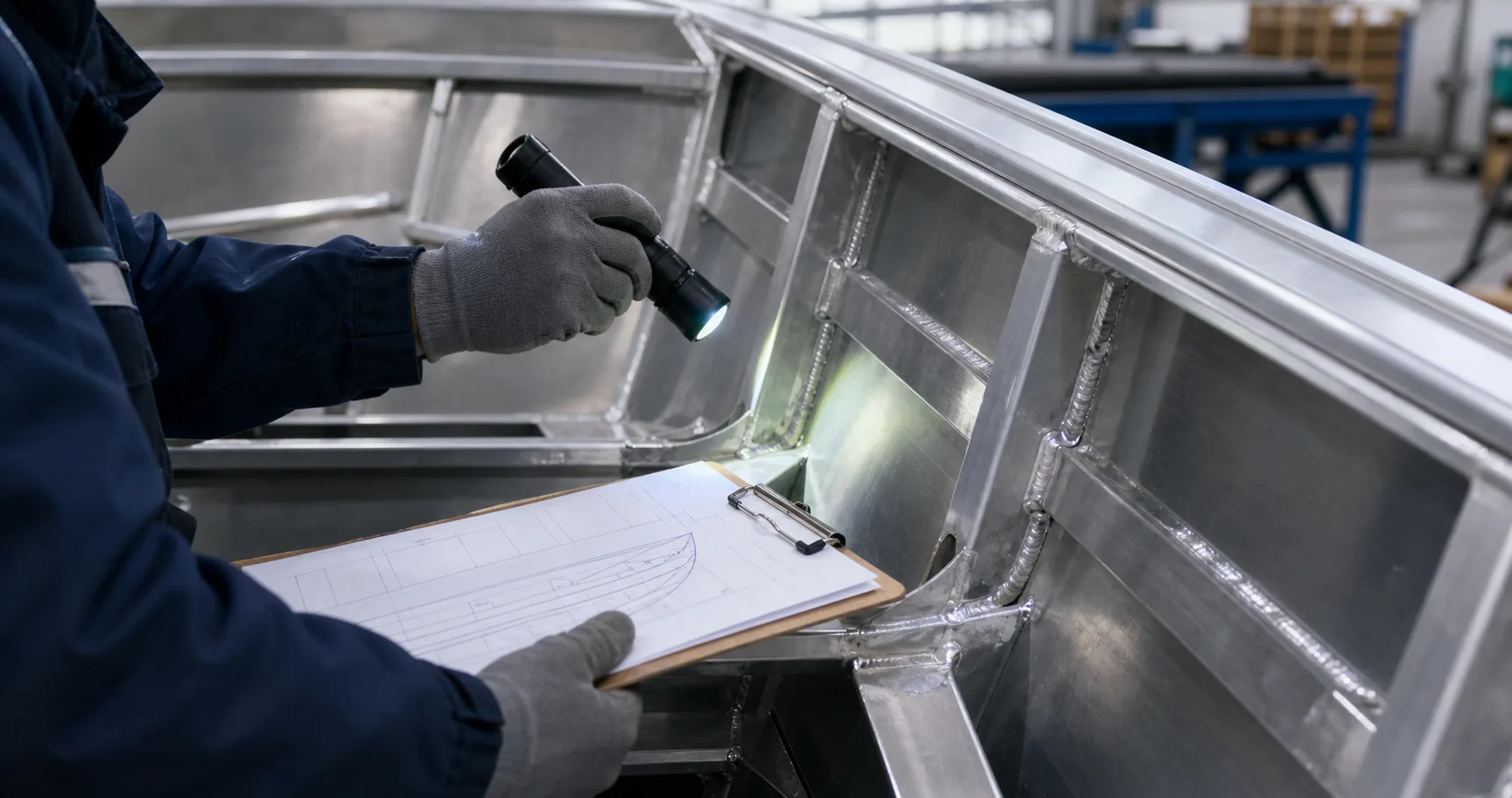
Aluminum grade and thickness should be discussed by structural area rather than reduced to one marketing number. Ask which alloy and thickness are proposed for the bottom, sides, deck, tubes, transom and other relevant parts of the selected design. Then ask what records can connect supplied material with production.
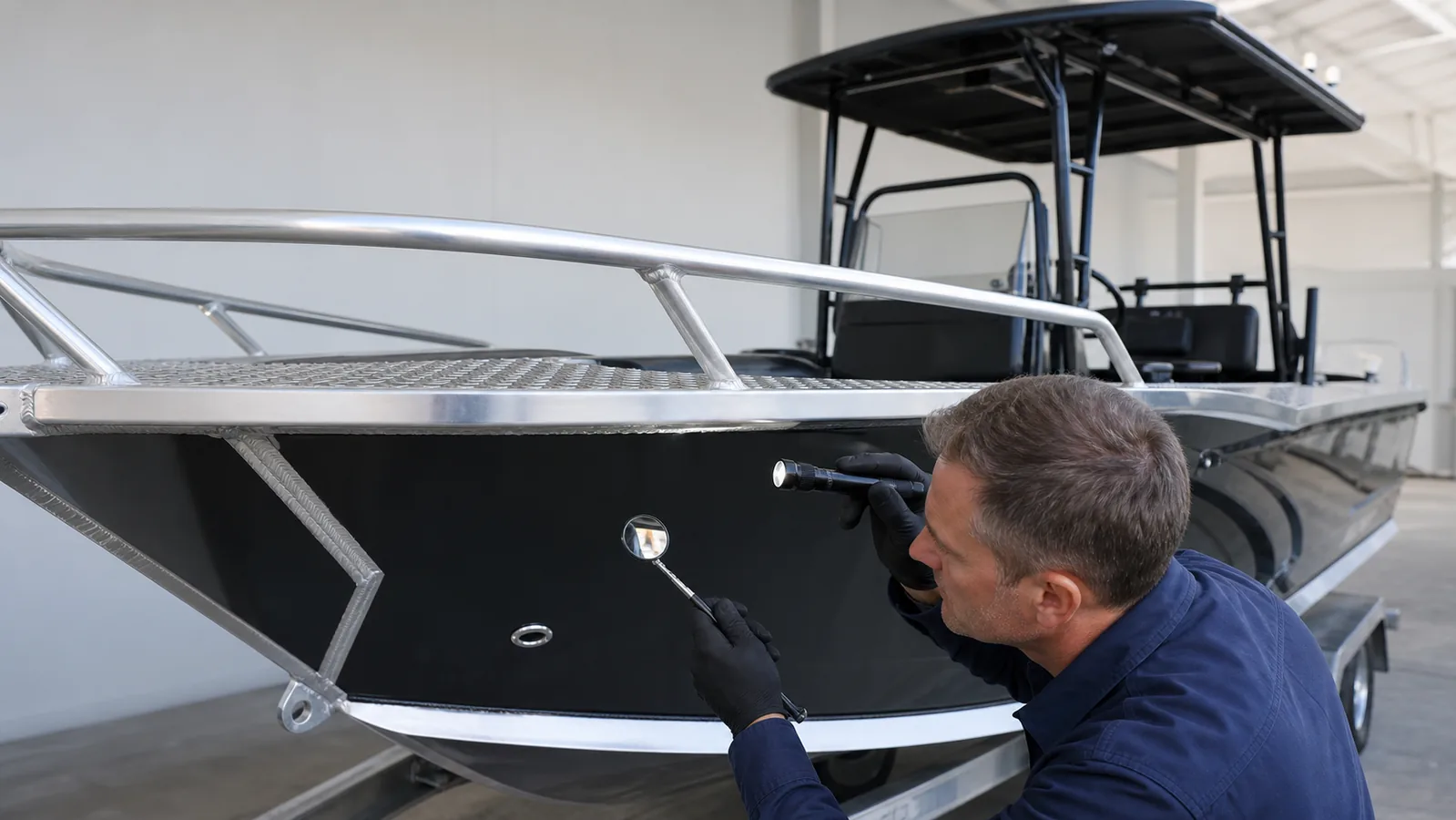
Construction review can include cutting and forming control, fit-up, welding process information, welder qualification where applicable, distortion control, watertight testing, coating or finish preparation, and protection between dissimilar materials. The exact evidence varies by product and factory system. The objective is traceability: the buyer should be able to see how the approved design becomes an inspected boat.
5. Review quality control as a sequence
Quality control is more useful when explained as checkpoints than when presented as a general promise. Ask the manufacturer to describe the inspection path from incoming material through fabrication, assembly, systems installation, finish, function checks, final inspection and packing. Determine which records are standard, which can be shared, and which inspection points can include the buyer or an independent inspector.
A practical project quality plan may identify drawing approval, material verification, dimensional checks, weld or watertight checks, electrical and equipment inspection, engine or propulsion installation review, final appearance, inventory, documentation and packing evidence. Not every boat needs the same plan, but the selected plan should be agreed before production.
Kinocean publishes an overview of its evidence and process on Proven Quality. Buyers should still request the records that apply to their ordered model rather than treating a general quality page as a substitute for project documentation.
6. Confirm certification and document scope precisely
The presence of a certificate, examination report or CE mark in a supplier’s materials should trigger a model-level review. Ask for the document number, named manufacturer, product description, model, design category, dimensions, conformity route, issue and expiry dates, and issuing or notified body details where relevant. Check whether the proposed changes remain within the document scope.
Certification scope must be checked for the selected model, configuration and destination requirements. A report for one pontoon model is evidence for that named model and scope; it should not be described as automatic coverage for every pontoon, fishing boat, jet boat or destination. Import, registration, equipment and operating rules may also involve local authorities or professionals.
The buyer should list required documents in the request for quotation. Depending on the project, the list may include drawings, specifications, manuals, declarations, examination reports, material or inspection records, packing lists and origin or shipping documents. The manufacturer should mark each item as included, available on request, supplied by another party or requiring confirmation.
7. Evaluate OEM and ODM control, not just flexibility
Customization is valuable only when changes are controlled. For an OEM or ODM program, ask how the supplier handles requirements, concept review, engineering ownership, drawing approval, prototype or first-article checks, change control, branding files, tooling, testing, confidential information and later revisions. Clarify which design elements are established options and which require new engineering.
A clear customization process protects both sides. It prevents a buyer from assuming that a visual layout change has no structural or documentation impact, and it prevents a factory from substituting an option without approval. The project brief should also state target markets, forecast or initial quantity, service model and the expected responsibility for local validation.
Use the aluminum boat buyer planning charts to organize use-case questions before issuing an OEM or fleet brief.

8. Test communication with a structured quotation
Communication quality can be evaluated before an order. Send the same concise brief to shortlisted suppliers and observe whether they identify missing inputs, distinguish confirmed facts from estimates, return a matched drawing and specification, and make exclusions visible. A useful quotation allows two people to understand the same scope later.
Normalize the commercial comparison. Confirm currency, payment stages, validity, production estimate, inspection point, Incoterm, packing, freight responsibility, engine and trailer inclusion, spare parts, documents, warranty path and local preparation. Lead time and price should remain project-specific because configuration, order quantity, material availability, production loading and delivery route can change them.
9. Plan service, parts and dealer responsibilities
After-delivery support is a system of assigned responsibilities. Ask who diagnoses an issue, what evidence is required, who approves a remedy, how parts are identified and shipped, what is excluded, and which work must be completed locally. Engine, electronics, trailer and other third-party equipment may have separate support routes.
Dealers should go further by discussing parts stocking, documentation, product updates, sales territory, demonstration units, lead handling, training, marketing assets and customer handover. A dealer relationship should connect repeat supply with local service capability. Prospective partners can review the Kinocean dealer program and then request written terms for their market.
10. Use a scored supplier review
A scorecard helps a buying team avoid giving the headline price more weight than project risk. Assign a weight to each decision area, record the evidence received, and leave a field for unresolved questions. A simple evaluation can cover application fit, drawing and specification quality, construction evidence, quality records, document scope, customization control, communication, total landed project cost and service responsibility.
Scores should support judgment rather than replace it. A supplier may be appropriate for a repeat dealer program but not for an urgent local replacement. Another may offer strong local service but limited configuration. The correct route depends on the buyer’s capabilities and priorities.
Questions to send with an aluminum boat RFQ
- Which model and drawing revision match the stated application?
- Which specifications and options are confirmed, and which remain open?
- What material and construction information is available for this configuration?
- Which quality checkpoints and records are included?
- Which certificates or technical documents apply to this exact model?
- What is included or excluded for propulsion, trailer, equipment, packing and delivery?
- How will changes, inspection, warranty communication and spare parts be managed?
For a second sourcing perspective, read the neutral China manufacturer vs local supplier comparison. It explains when direct, local and hybrid routes may fit different buyers.
Frequently asked questions
What should buyers evaluate when choosing an aluminum boat manufacturer?
Evaluate project fit, documented specifications, material and construction evidence, drawings, quality-control records, model-specific certification scope, communication, service planning and the ability to confirm a quotation for the destination and operating requirements.
How can a buyer verify aluminum material and construction details?
Request the material grade and thickness by structural area, current drawings, welding and construction information, inspection checkpoints and the records available for the selected model. Final construction details should match the approved drawing and quotation.
Does one certificate cover every boat from a manufacturer?
No. Certificate and examination-report scope should be checked against the selected model, configuration, applicable requirements and destination. Buyers should request the relevant document rather than assume universal coverage.
What should an OEM or ODM aluminum boat brief include?
Include the target market, use case, operating water, quantity, reference model, required layout changes, propulsion direction, equipment, branding, testing, documentation, packing and delivery responsibilities.
What information helps a manufacturer prepare a useful quotation?
Provide the buyer type, country, application, normal route and water, passenger or load target, model direction, quantity, options, engine and trailer scope, required documents, destination and timing expectations.
Share this article
Have a boat project in mind?
Share your market, quantity plan and boat use. Kinocean can help narrow the model direction before you request a detailed quote.